
ghostofamerica book design

David John Baer McNicholas

David John Baer McNicholas

Books are artifacts of culture. Working class authors have contributed some of the most lasting and affecting work.

David John Baer McNicholas was a residential renovator for twenty years. He connects with the spirit of manual labor, the presence of lived-in spaces, and the vital exchange of knowledge between the living and the living and the living and the dead. David lives in a bus on the high desert mesa in Madrid, NM, with two cats: Oliver and Lady Jane. He is the author of Lemons: In an Orchard and has several manuscripts in process. His short stories, poems, and visual art have appeared in a handful of publications in print and on the web.

He is a graduate of the creative writing program at The Institute of American Indian Arts, where he concentrated in fiction, poetry, and graphic narrative, and studied disciplines as diverse as anthropology and studio arts. He reads nonfiction for BendingGenres.com and moonlights as a noise musician under the name c}{imps 8 my ears.

He loves doom jazz, tostones, and absurdist films.

Books

Lemons: In an Orchard

Novel

A man thrashes repeatedly against his own self-awareness until he breaks through into an en-stranged world where his usual handles fail him.

Slingshot

Novel in prose and verse, with color plates

A story about agency, division, and media. Absurd, brutal, tender. Where canned food is outlawed, they have built a giant trebuchet to hurl illicit provisions, further than the eye can see. They are very smug about it, until the thank-you notes arrive — hails Mary, tied to bricks.

Secret History of Roadside Attractions

Short stories

The weird and spectacular, built as monuments to wonder. A child harvests muddy fruit from an estuary. A mouse in an experiment. A truck that travels out of alignment with the universal clock. A person who wishes for lightning.

Library of Branches

Poetry

20th century science as fable. Assemblage and tinker. Wilderness tuned to static. Decoded light.

Library of Branches

Visual art and poetry — graphic chapbook

Light between branches barefoot. Night is dark and full of shapes.

Fully Funded: The Creative Writing MFA Application Process

Nonfiction

The author shares his experience applying for some of the top creative writing programs in the United States. A practical, spiritual path and exploration of discipline.
CV

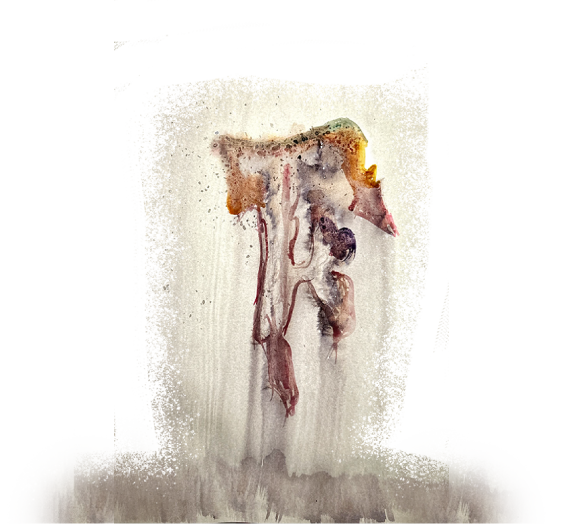
Stool Glyph, mixed media artwork

Achievement & Experience

Stool Glyph by David John Baer McNicholas

2021–2026
Creative Writing Dept. Mentor, Institute of American Indian Arts
2022
Betty and Norman Lockwood Poetry Prize, IAIA
2022–2025
President’s List, Institute of American Indian Arts (multiple years)
2022–2025
Award for Outstanding Work in Creative Writing, IAIA (multiple years)
2022–2024
Truman Capote Scholarship (multiple years)
2023–2024
Founding Editor, Young Warrior, Institute of American Indian Arts
2024
Creative Nonfiction Editor / Blog Development, Bendinggenres.com
2024
Naropa University Summer Writing Program — full scholarship
2025
Inducted, Alpha Chi, Institute of American Indian Arts
2025
Editor & Designer, IAIA Student Anthology: Limn/Limb
2026
Editor & Designer, IAIA Student Anthology: Rabbits Grind Their Teeth
2026
Founded ghostofamerica book design

Selected Publications

2022
“Flatbed,” poem — Poets.org
2023
“Per Castra Ad Astra,” CNF — Panorama Travel Journal
2023
“In a Photograph Flash,” fiction — Bending Genres
2023
“Upside Down,” graphic novella — JMWW
2023
Poetry — Rougarou
2023
Artwork — Ignatian Literary Magazine; Trace Fossils Review
2024
“A Mighty Yank,” fiction — Hearth & Coffin
2024
“Arms, Crossed Behind Her,” poetry; “Map 050,” visual art — Landlocked
2024
Cover art contest winner — Stonecrop No. 7
2024
“Poly Bloom,” fiction — Waymark

Statement on AI

The only thing I can state with conviction is that AI use should be disclosed.

I do not use AI in my typesetting work, nor do I use it to write or create visual artwork. Some clients use it for their artwork. It’s not for me to judge. Credit where credit is due, of course. The implication when someone uses and credits AI is that, back of that, there are millions of uncredited artists whose work has been mined. The same is true for code development, no? The well-intentioned rat’s nest of copyright law has failed to protect working class artists since its inception. AI did not create this ethical dilemma, but it has heightened it.

This website was coded with an immense debt to Claude.ai. Without its direct support, I’d just have a landing page. I wouldn’t fault you for thinking that would be better. Corporations are invading working class communities all over world with AI data centers. It’s a new form of corporate gentrification for robots and shareholders.

Corporations are not, of themselves, problematic. AI, the same. Even capitalism has existed for thousands of years as mercantilism, without being a huge problem. Something in the scale and implementation of 20th/21st century consumer capitalism and shareholder profit driven corporate motivation combined with a global phenomenon of consolidation and compression is driving toxic relationships between human progress and global personhood. I don’t have the answer.

Meanwhile… we all continue to do our best and be open to dialog. Being working-class artists, let’s avoid the crab-bucket mentality. We all want a better world. We don’t often agree on what that looks like, but I must believe we can do better if we are willing to see and hear each other out.